
For adults looking to gain their speech back…
Helping Recover and Enhance Speech With Daily Practice
Without complicated medical programs, or feeling embarrassed in front of family and friends…
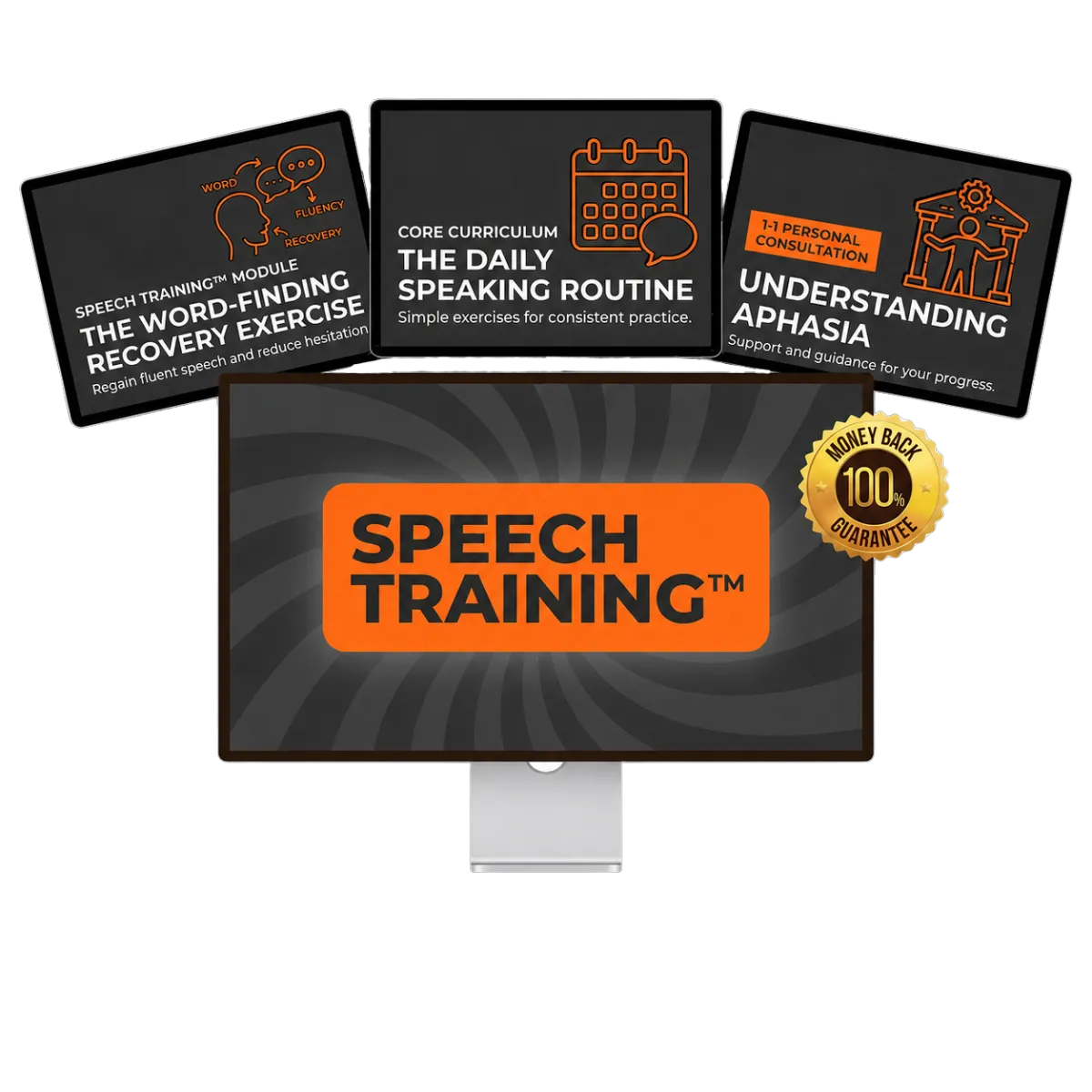
Here's a snapshot of what you're getting in The "Aphasia" Speech Training System
*Win your speaking confidence back, or you don’t pay
There's an evidenced based approach helping adults with Aphasia speak more fluently...
When words don’t come, ideas don’t flow, and speaking feels hard, it all weighs on your confidence…
You know you have thoughts, you just can’t let them out…
But avoiding to speak isn’t going to make things better, if anything, it can make communication more difficult.
But what if you could speak more fluently by working with a part of your brain that still supports language?
WITH a part of your brain that already knows how to do it, rather than struggling against the part that's broken?
Researchers have found that automatic or overlearned speech such as greetings, prayers, counting, songs, or common phrases may remain available to some people with aphasia even after other language abilities are affected. [1][2]
This part of language can still remain accessible even when everyday speech is difficult. [3]
Allowing you to regain your ability to speak, find your words, and communicate with confidence…
When therapy focuses less on effortful word-finding and more on familiar, overlearned speech patterns, communication may begin to feel more natural and automatic.
For many people with aphasia, familiar phrases, rhythms, greetings, songs, or conversational patterns can remain easier to access than generating new language from scratch.
With consistent guided practice, some people can strengthen these automatic speech patterns and improve everyday communication with practice each day.
You can begin practicing these techniques at home using these three simple steps.
Here’s How These Exercises Helps Adults Strengthen Their Speech In 4 Simple Steps

Step 1
Identify Your Speech Breakdown (Understanding Aphasia)
When a stroke or brain injury affects communication, understanding why speech feels difficult is the first step toward improvement.
Learn how aphasia can affect word-finding, fluency, comprehension, memory, and conversation — and begin identifying which areas are impacting you most.
By pinpointing where communication is breaking down, you can focus your practice where it matters most instead of wasting energy on strategies that don’t fit your needs.
Step 2
Learn Compensatory Strategies
When speech doesn't come easily, don't let the conversation stop.
Discover 'Compensatory Strategies'—practical workarounds like gestures, symbols, and environmental shifts to help you or your loved one communicate clearly today.
Watch to see how these simple changes make meaningful difference in aphasia recovery.

Step 3
Consistent Daily Practice
Use short, guided exercises built around language patterns your brain already knows well such as familiar phrases, rhythms, greetings, and overlearned speech.
For many people with aphasia, these automatic forms of speech can remain more accessible even when conversation feels difficult.
With just a few minutes of consistent daily practice, you can begin strengthening speaking confidence and improving communication in a supportive, low-pressure way.

Step 4
Lock In Long-Term Speaking Gains
Use evidenced based techniques to strengthen what you’re relearning, so that progress can remain consistent over time.
Use specific reinforcement techniques that make your progress permanent, so you're not just having a "good day," but genuinely getting better week after week.
Yes - This Is Really WHAT You Need
Whether you’ve been living with speech difficulties for years…
Or you’ve only recently noticed that words aren’t coming as easily as they once did…
One thing is clear: when communication becomes difficult, it can affect your confidence, your relationships, and the way you feel in everyday conversations and social situations.
Many people find that progress begins when they stop forcing words to come out and start practicing in ways that feel more natural, supportive, and less overwhelming.
This approach is designed to provide a simple, structured way to practice at home using practical routines you can begin using right away.
*Win your speaking confidence back, or you don’t pay
Here’s everything you get when you join the...
The "Aphasia" Speech Training System
Discover the science-backed exercises that use familiar phrases, and repetition to support fluent speech and help you recover your speech abilities….
These techniques may help reduce effortful word finding and engage language patterns that may still be accessible.
You’ll see how to bypass the blocks that keep you stuck and feeling like you’re “fighting” to get words out of your mouth…
And re-cover your still intact speech abilities in your brain.[8][9]
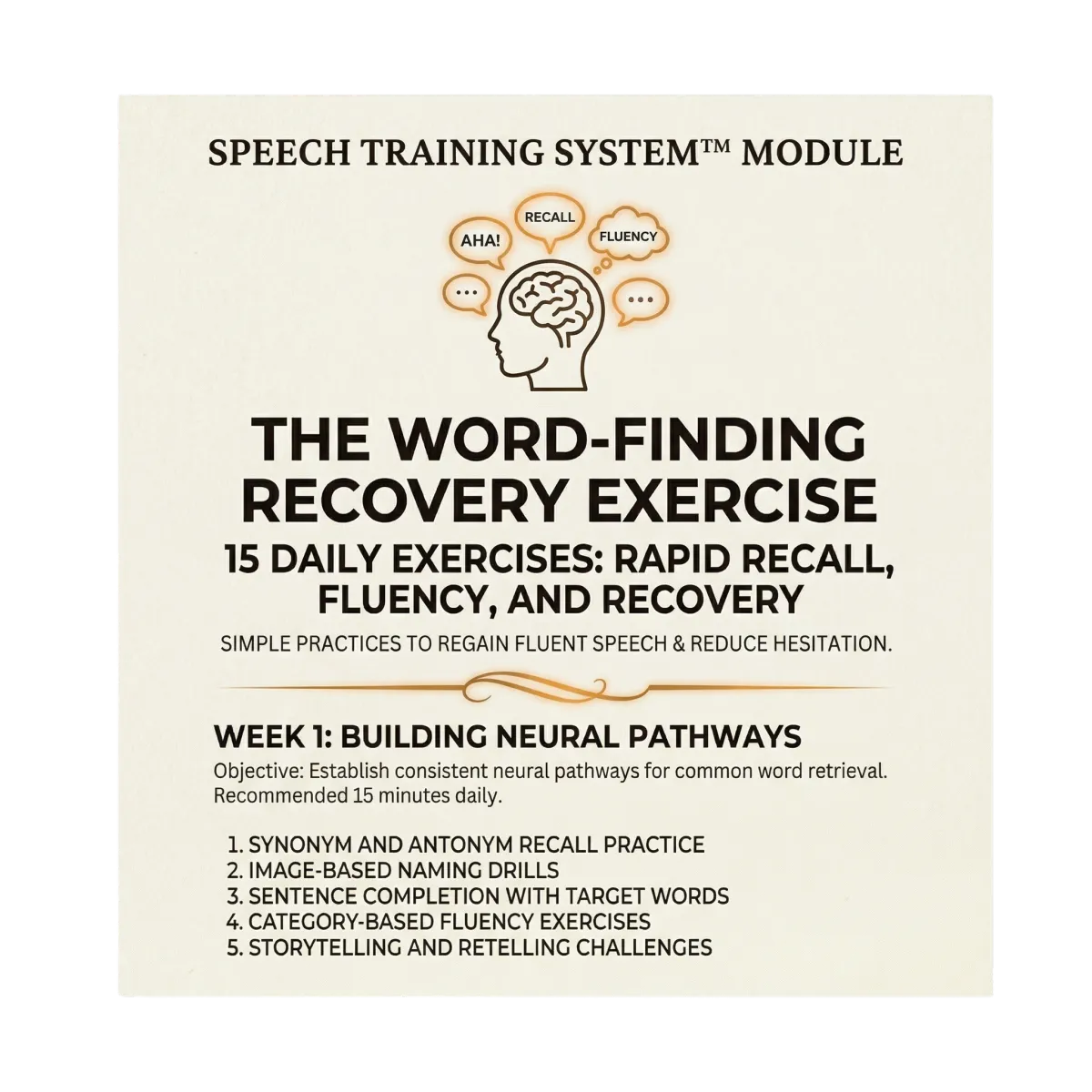
The Word-Finding Recovery Exercise
Many adults with aphasia describe the frustration of knowing exactly what they want to say, but not being able to find the right word in the moment.
Learn practical word-finding strategies designed to support communication during everyday conversations.
These techniques can help reduce those “going blank” moments and make it easier to express yourself with greater confidence during conversations with family, friends, and others.
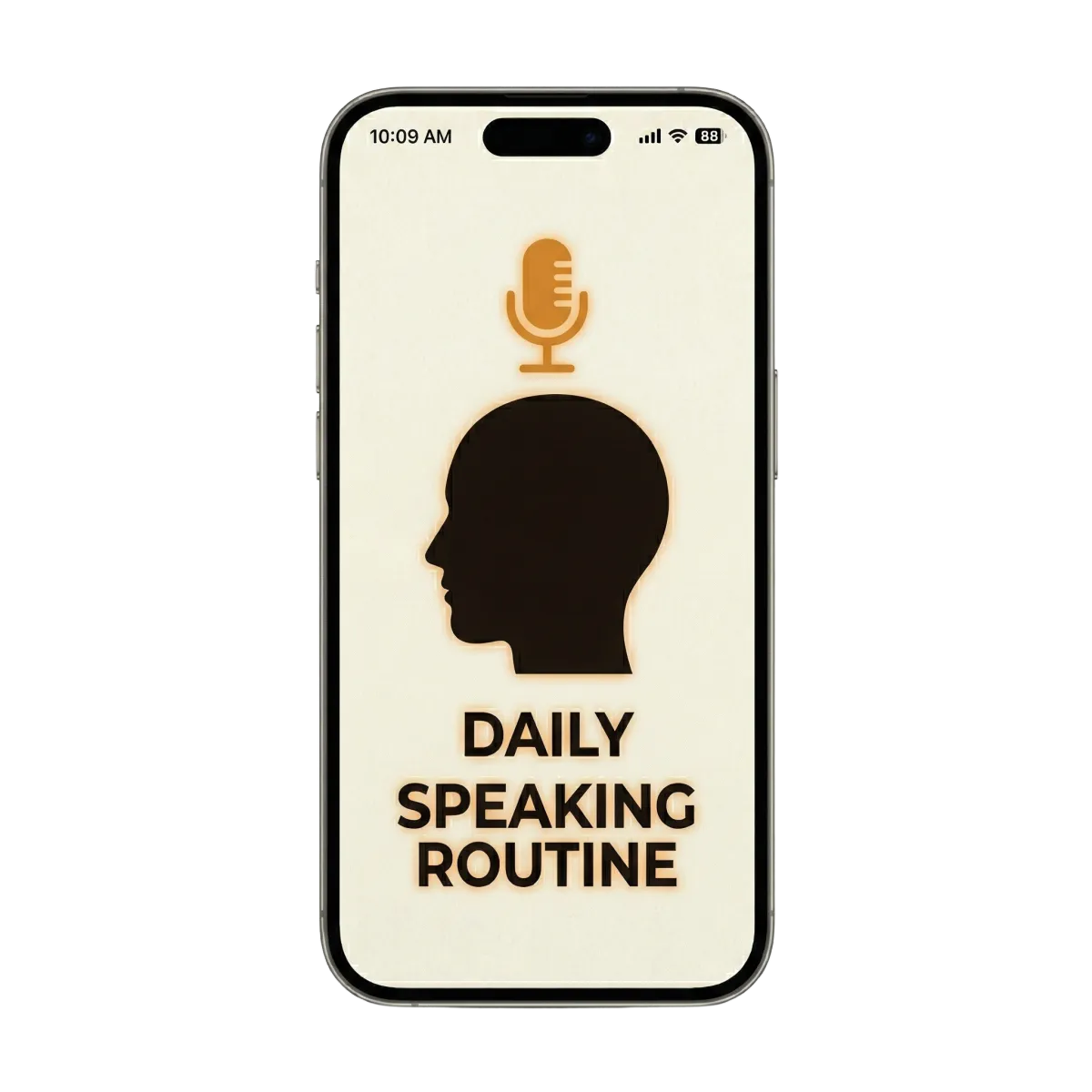
The Daily Speaking Routine
Use this simple daily practice to support speaking fluency in just a few minutes a day, helping you build consistency without feeling overwhelmed.
The method uses familiar phrases and overlearned language patterns that are often easier to access than generating new words from scratch.
For many people with aphasia, these automatic forms of speech may remain more accessible even when word-finding is difficult.
It’s designed to be simple, structured, and low-pressure so you can practice comfortably at home.
The exercises incorporate rhythm, repetition, and familiar language patterns to support engagement and make practice feel more natural and manageable.
And it's designed to be easy and enjoyable, not clinical or frustrating, so you actually look forward to doing it every day from the comfort of your home
BONUSES
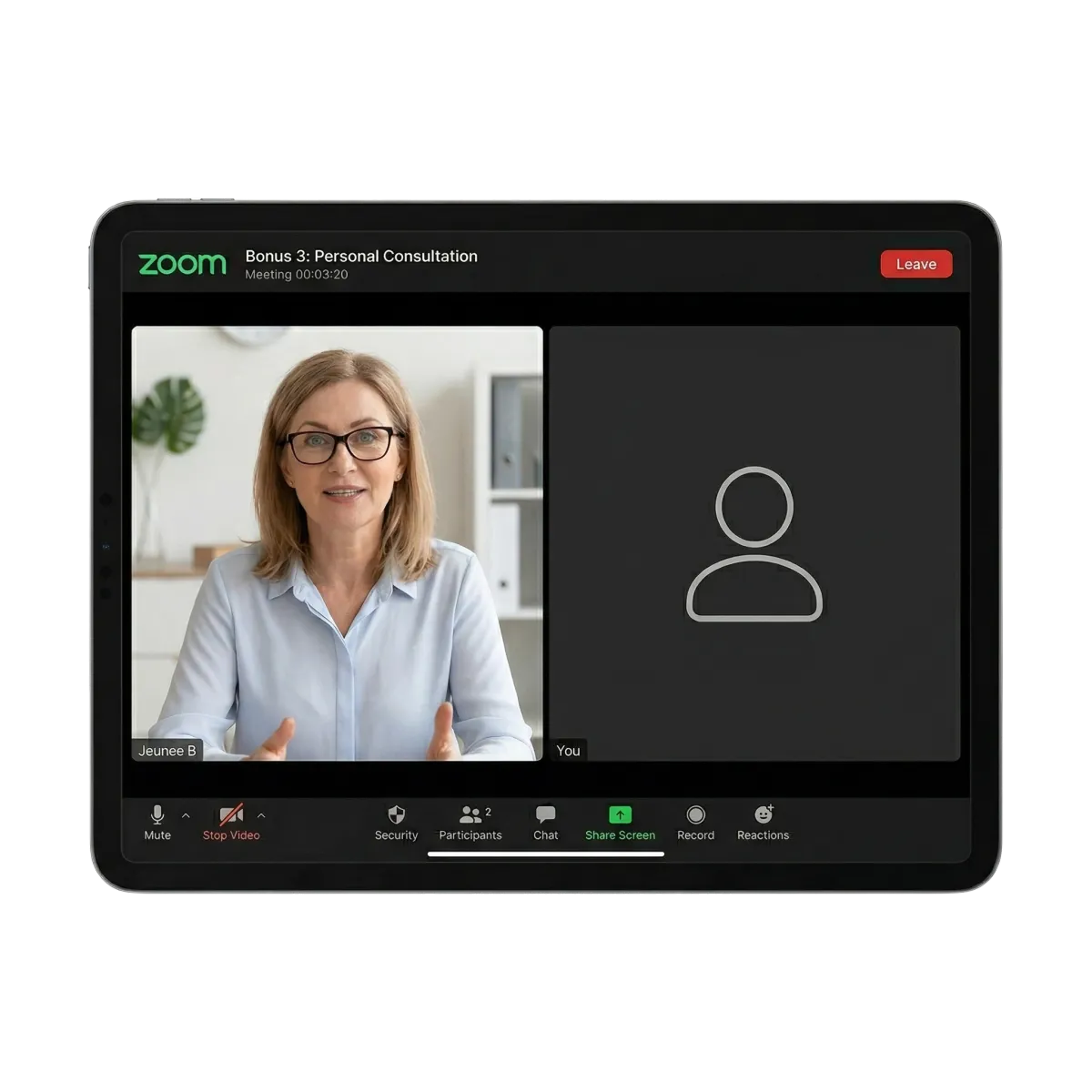
Bonus 1:
Personal Consultation Speaking Assessment Session
Get a personalized 15 -minute consultation with a licensed speech language pathologist to help tailor your training to your specific communication needs, goals, and daily routine.
During this one-on-one Zoom session, you’ll review your current speaking strengths and identify the areas where you may benefit from additional support.
Together, you’ll create a customized daily practice plan designed for your situation, and you’ll have the opportunity to ask questions about how to apply the exercises at home.
You’ll leave the session with clear guidance and a structured plan to help you begin practicing with more confidence and direction.
*Win your speaking confidence back, or you don’t pay

*Win your speaking confidence back, or you don’t pay
Hi, I'm Juenee Browne

Hi, I'm Juenee Browne
I’m a certified speech-language pathologist who works with adults experiencing speech and language difficulties.
Over the past six years, I’ve had the privilege of working directly with individuals who feel frustrated, self-conscious, or discouraged about their communication.
In my clinical work, I’ve seen how structured, consistent practice, especially when it builds from preserved strengths, can support meaningful improvements in confidence and everyday communication.
I created this program to make that kind of structured practice more accessible outside of one-on-one sessions.
It’s designed to be simple, affordable, and realistic to use at home, particularly for individuals with non-fluent aphasia who want guided daily practice between therapy sessions or after formal therapy has ended.
If you’re looking for a structured way to work on word-finding and speaking confidence in a supported, home-based format, this program may be a helpful option.
If it’s not the right fit, there is a full money-back guarantee.
What Happens When You Stop Struggling
and Start Practicing
These are the words of parents, caregivers, and professionals who witnessed real communication breakthroughs — firsthand.
" My son Greyson was struggling to find his words, and I was terrified that virtual learning during the pandemic would set him back even further. What I didn't expect was a therapist who showed up for our entire family — not just him. She sent resources, checked in constantly, and taught in a way Greyson could actually understand. For the first time, I felt like someone genuinely cared whether he made progress, not just whether the sessions were completed.
- ✔ Consistent progress through remote & blended learning
- ✔ Whole family included and supported
- ✔ Home resources that reinforced daily communication skills
" When Amir started at his new school, he was completely non-verbal and we were learning everything remotely. I was overwhelmed. But she never gave up on him — or on me. She patiently brainstormed with me, adapted her approach to meet Amir exactly where he was, and guided us through getting him a communication device that changed his life. He uses it to this day. That's not just therapy. That's transformation.
- ✔ Non-verbal student gained a functional communication device
- ✔ Parent-therapist collaboration that actually worked
- ✔ Customised approach that met the student's exact needs
" In over 15 years as a Speech-Language Pathologist, I've worked alongside many clinicians — few stand out the way she does. She builds real rapport with students, collaborates seamlessly with teachers and care staff, and adapts without hesitation when caseloads or challenges shift. Her proficiency with both low- and high-tech AAC systems is exceptional. She doesn't just treat students — she advocates for them. I endorse her without reservation.
- ✔ Certified expertise in low- and high-tech AAC systems
- ✔ Trusted by senior colleagues across disciplines
- ✔ Adapts fluidly to complex, changing student needs
Speak With Confidence Or Money Back Guarantee
.

We want you to feel comfortable trying these strategies, so every purchase comes with a 90 day satisfaction guarantee.
Our goal is to make it easy to get started so you can focus on practicing and improving your communication skills without added pressure.
Try the Aphasia Speech Training with a 90-day satisfaction guarantee.
If you don’t feel it’s the right fit for you, you can request a full refund within that period.
Yes — you can use our support email [[email protected]] to get a full refund anytime within 60 days (we usually reply within 24 hours).
No questions asked. No risk.
*Win your speaking confidence back, or you don’t pay
Frequently Asked Questions
This method helps you strengthen speech patterns your brain already knows well.
By practicing familiar phrases, rhythms, and overlearned language, you can support more natural communication, even when everyday word-finding feels challenging.
With simple daily exercises and routines, this approach can help you speak with greater confidence and ease from home.
Q1 What is the Aphasia Speech Training?
Aphasia Speech Training is a structured, home-based practice program designed to support communication in adults with aphasia.
It uses guided exercises focused on repeated practice of spoken language, familiar phrases, and structured communication tasks.
The program is intended to provide a consistent framework for practicing speech outside of formal therapy sessions.
Q2 Will this work for me even if I've been struggling with my speech for a long time?
Recovery and improvement in communication can vary widely between individuals.
Research in stroke and aphasia rehabilitation shows that some people continue to make gains in communication abilities over time, including in the chronic stages after injury.
This program is not designed to restore or repair specific brain areas. Instead, it provides structured practice to support communication skills through repetition and functional use of language.
Individual results will vary depending on factors such as the nature and severity of aphasia, time since injury, and frequency of practice.
Q3 How long will it take to see results?
Some individuals may notice changes in confidence or ease of communication over time, while others may require longer periods of consistent practice.
Progress is gradual and depends on regular use of the exercises.
Q4 Do I need any special equipment or technology?
No.
The program is designed to be used at home with simple materials such as spoken practice, written prompts, and everyday objects.
Q5 Is this a replacement for professional speech therapy?
No.
Aphasia Speech Training is a self-directed practice program intended to complement, not replace, services provided by a licensed speech-language pathologist.
It is not a medical treatment and does not replace professional evaluation or therapy.
Individuals should consult a qualified healthcare professional regarding their specific communication needs.
Q6 Is there personalized support available if I need help?
Yes! Your purchase includes a personal 30 -minute consultation with a certified speech-language professional who will customize the Speech Training for your specific needs.
Additionally, we offer email support for any questions that arise as you implement the program.
Q7 Is there a guarantee?
Absolutely! We offer a full 90-day money-back guarantee. If you don't see meaningful improvements in your speaking confidence, word-finding, or daily communication, simply email our support team for a complete refund — no questions asked.
Q8 I'm ready to start speaking with confidence again. How do I get started?
Simply click the "Get Started Now" button below, complete your secure purchase, and you'll receive immediate access to all program materials and bonuses. You'll also receive instructions to schedule your personal speaking assessment session with a certified speech-language professional.
*Win your speaking confidence back, or you don’t pay
SCIENTIFIC REFERENCES
Each numbered reference below corresponds to a bracketed number [X] in the sales page above. These are from peer-reviewed journals and government-hosted research databases (PMC/NIH, Oxford Academic, Frontiers).
[1] Automatic speech is preserved even after severe brain damage — and it's controlled by a different part of the brain than regular speech.
Source: Van Lancker Sidtis, D. "The Affective Nature of Formulaic Language: A Right-Hemisphere Subcortical Process." Frontiers in Communication, 2018. Published on: NIH National Library of Medicine (PMC) URL: https://pmc.ncbi.nlm.nih.gov/articles/PMC6066536/
Key finding: "Starting with J. Hughlings Jackson in the nineteenth century, clinicians with exposure to aphasia noted that fixed, holistic, known utterances are well-preserved despite severe language impairment… Examination of monologs from persons with left hemisphere damage and aphasia reveal high proportions of formulaic expressions, while right hemisphere damage is associated with significantly lower proportions."
[2] The brain uses two separate systems for language — one for regular speech and one for automatic/formulaic speech.
Source: Sidtis, D. Van Lancker, et al. "Switching Language Modes: Complementary Brain Patterns for Formulaic and Propositional Language." PMC, 2018. Published on: NIH National Library of Medicine (PMC) URL: https://pmc.ncbi.nlm.nih.gov/articles/PMC5899291/
Key finding: "Propositional language and formulaic language differ not only in linguistic form and function but in their neurological organization as well… Many aphasic individuals retain an expressive ability, originally referred to as automatic speech."
[3] Even after an entire left hemisphere was removed, a patient retained the ability to produce automatic speech — proving these language abilities are stored in a completely different brain system.
Source: Van Lancker Sidtis, D. "Cortical-subcortical production of formulaic language: A review of linguistic, brain disorder, and functional imaging studies leading to a production model." PMC, 2018. Published on: NIH National Library of Medicine (PMC) URL: https://pmc.ncbi.nlm.nih.gov/articles/PMC6310163/
Key finding: "An early study of a normally developing adult who underwent a left hemispherectomy for cancer treatment, resulting in a profound aphasia, revealed a store of residual expressions including expletives, pause fillers, and conversational speech formulas… strongly attributing this residual, pragmatically-based speech competence to the remaining right hemisphere."
[4] Singing and rhythmic exercises activate the undamaged right hemisphere — bypassing the broken speech centers.
Source: Schlaug, G., et al. "From Singing to Speaking: Facilitating Recovery from Nonfluent Aphasia." Future Neurology, 2010. Published on: NIH National Library of Medicine (PMC) URL: https://pmc.ncbi.nlm.nih.gov/articles/PMC2982746/
Key finding: "It has been reported for more than 100 years that patients with severe nonfluent aphasia are better at singing lyrics than they are at speaking the same words… Recovery from aphasia can happen through the recruitment of homologous language and speech-motor regions in the unaffected hemisphere."
[5] Preserved formulaic language skills can be used as a therapeutic tool to overcome speech difficulties.
Source: Stahl, B., et al. "Formulaic Language Resources May Help Overcome Difficulties in Speech-Motor Planning after Stroke." PLOS ONE, 2020. Published on: NIH National Library of Medicine (PubMed) URL: https://pubmed.ncbi.nlm.nih.gov/32497064/
Key finding: "Statistical analyses revealed significant increases in correctly produced word onsets after verbal cues with distinct features of formulaicity… The current results indicate that using preserved formulaic language skills can relieve word-onset difficulties."
[6] At-home speech exercises produce real results through neuroplasticity — the brain's ability to rewire itself.
Source: Mohr, B. "Neuroplasticity and Functional Recovery after Intensive Language Therapy in Chronic Post Stroke Aphasia: Which Factors Are Relevant?" Frontiers in Human Neuroscience, 2017. Published on: NIH National Library of Medicine (PMC) URL: https://pmc.ncbi.nlm.nih.gov/articles/PMC5487528/
Key finding: "Neuroscience-based interventions for aphasia are among the most promising approaches toward successful language rehabilitation. Associated therapeutic techniques are highly effective in reducing cognitive-behavioral difficulties resulting from brain damage and can induce neuroplasticity."
[7] The brain can continue to recover and improve language abilities even years after the initial damage — not just in the first few months.
Source: Kiran, S. & Thompson, C.K. "Neuroplasticity of Language Networks in Aphasia: Advances, Updates, and Future Challenges." Frontiers in Neurology, 2019. Published on: NIH National Library of Medicine (PMC) URL: https://pmc.ncbi.nlm.nih.gov/articles/PMC6454116/
Key finding: "While it is well-documented that the greatest changes in the neural architecture for language occur in early stages of recovery, neuroplasticity occurs even in chronic aphasia, when neurophysiological repair processes have largely been completed… Neural networks are dynamic constructs which undergo remodeling throughout the lifespan based on experience."
[8] Patients with severe speech impairment can often sing entire pieces of text fluently — proving the "Black Box" (automatic speech system) is intact.
Source: Schlaug, G., et al. "From Singing to Speaking: Why Singing May Lead to Recovery of Expressive Language Function in Patients with Broca's Aphasia." Music Perception, 2008. Published on: NIH National Library of Medicine (PMC) URL: https://pmc.ncbi.nlm.nih.gov/articles/PMC3010734/
Key finding: "It has been reported that patients with severely nonfluent aphasia are better at singing lyrics than speaking the same words… Because of its potential to engage/unmask language-capable regions in the unaffected right hemisphere, MIT is particularly well suited for patients with large left-hemisphere lesions."
[9] Singing-based exercises produce measurable structural changes in the brain — actual physical rewiring.
Source: Siponkoski, S-T., et al. "Structural Neuroplasticity Effects of Singing in Chronic Aphasia." eNeuro, 2024. Published on: eNeuro (Society for Neuroscience) URL: https://www.eneuro.org/content/11/5/ENEURO.0408-23.2024
Key finding: "Music-based interventions, such as singing, are feasible tools to promote language network recovery… Simply listening to vocal music has been demonstrated to activate language-related regions of the brain, even in the case of acute stroke."
© Copyright 2025 The "Aphasia" Speech Training System™ - All rights reserved
This site is not a part of the Facebook website or Facebook Inc. Additionally, this site is NOT endorsed by Facebook in any way. FACEBOOK is a trademark of Facebook Inc.
This site is not a part of the Google or Youtube website or Google Inc or Youtube. Additionally, this site NOT endorsed by Google or Youtube in any way. GOOGLE & YOUTUBE are a trademark of ALPHABET, Inc.